Does someone in your life believe that vaccines cause autism? Do you know where this idea came from? I’m sure you’d be shocked to find that this controversial belief can be, in part, blamed on journalists. Though journalists strive to be unbiased arbiters of the truth, their methods are not iron-clad and they sometimes fall victim to bias and ignorance.
On February 28, 1998, a scientific study was published to the highly respected medical journal The Lancet claiming a link between the vaccine for Measles, Mumps and Rubella (MMR), non-specific colitis and autism. Though the paper appeared reputable, closer examination proved that it was done improperly and came to wild conclusions based on very little evidence. The Lancet itself soon published its own paper entirely disproving the findings of the original study but the damage had already been done. The media had already picked up the story and began reporting on it.
The idea that vaccines were dangerous was such a tantalizing story that the media could not pass up the opportunity to report on it. However, evidence supporting this claim was hard to find because there was no evidence. As a result, the media would regularly interview the original author of the paper, Andrew Wakefield. Wakefield obviously believed that his study was credible and would talk endlessly about the dangers of the MMR vaccine and the newly “discovered” condition that caused autism in children, all without being scrutinized by the journalists interviewing him.
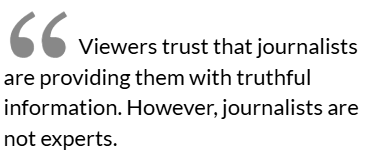
Viewers trust that journalists are providing them with truthful information. However, journalists are not experts. They aren’t more informed and do not have more training in scrutinizing sources than the average person. As a result, journalists will defer to experts who should know more than they do. But what if the “expert” they trust is feeding the public misinformation for their own goals? Of course, the scientific community was scrutinizing Wakefield’s paper and urging people to ignore him but most of the media did not present this feedback, so Wakefield’s voice dominated the conversation.
Another common sight during the MMR scare was journalists interviewing the parents of autistic children who blamed the MMR vaccine. These parents claimed that autistic symptoms began to arise soon after receiving a dose of the vaccine. One mother interviewed by the BBC even said her son had become autistic “literally overnight”. But these parents are not experts either, and fell victim to cognitive biases that led them to believe that these two completely unrelated moments definitely caused one another. Their fear was only confirmed by a bogus study being published and the media reporting on it as though it were fact. The media was trying to show the rising fear among the community but all they did was create more fear.
When watching the news or reading articles, always scrutinize the people who are being interviewed and their claims. Is this person an expert in what they are talking about? Do they have a vested interest in saying what they are saying? If they aren’t experts, then they should not be making claims of any kind. We interview everyday people to gather their emotional experience and their perspective but once they begin making claims, then that cannot be trusted.
Check where the journalist got their sources if they are making a claim of any kind. Check to see if the source comes from a reputable journal or if there has been any backlash against it. Possibly even read the original source yourself and see if you can catch any problems with it.
Finally, journalists ought to hold themselves to a higher standard when reporting on things they don’t know about. The public trusts them to be the arbiters of truth, so there needs to be more rigorous systems in place to prevent the truth from falling through the cracks like this again.
Though nearly 30 years have passed since the media began reporting on Wakefield’s study, we still see the same failings of the media to report the truth in all instances. The media will still push fearmongering narratives no matter the credibility of the sources, such as the current fluoride scare, and even push solutions to common problems that have no backing by the scientific community, like the many diets and supplements that come out seemingly every day. I cannot, in good conscience, say that all journalists are untrustworthy and neither should you believe that. But look for these faults in how journalists report on stories that cause the truth to fall through the cracks.